

What Is the CPV to CPA Conversion Table?
The CPV to CPA conversion table is an official reference prepared by statistical authorities that maps EU procurement CPV codes to CPA product classification codes. In short: on one side sits the language of public procurement (CPV); on the other, the language of production and capacity reporting (CPA). The table translates between them.
A company that wants to find the tender equivalent of its manufactured product — or that needs to match the right code when applying for a domestic-product certificate — must use this conversion. The wrong code can lead to missed opportunities and loss of price advantages.
Key Definitions: CPV, CPA, NACE, PRODCOM
To use the conversion table correctly you need to understand the five classification systems in the background. Each serves a different purpose and is used by different institutions, yet they are all hierarchically linked. NACE classifies general economic activities; CPA and PRODCOM are its product-level extensions; national lists adapt PRODCOM to individual countries.
The 8-digit European standard code used by contracting authorities to classify the subject matter of a tender. It determines which goods or services a tender covers.
The classification used in capacity reports to code machinery, equipment, and consumable goods. It forms the backbone of the domestic-product certificate process.
The parent system that classifies economic activities (production, service sectors); CPA and PRODCOM are derived from it.
The detailed list of EU industrial products; it is the more granular, product-level extension of the CPA code.
The list used to code production items in capacity report Table II. The first 6 digits of a PRODTR/PRODCOM code correspond directly to the CPA code.
Code Structure and the First-6-Digit Rule
PRODCOM codes follow an XX.XX.XX.XX.XX format — ten digits in five groups. The critical rule: the first six digits of a PRODCOM code correspond directly to a CPA code. So when you take the code for a production line from your capacity report, separate the first six digits to get the CPA code, then use the CPV-to-CPA table to find the matching CPV code.
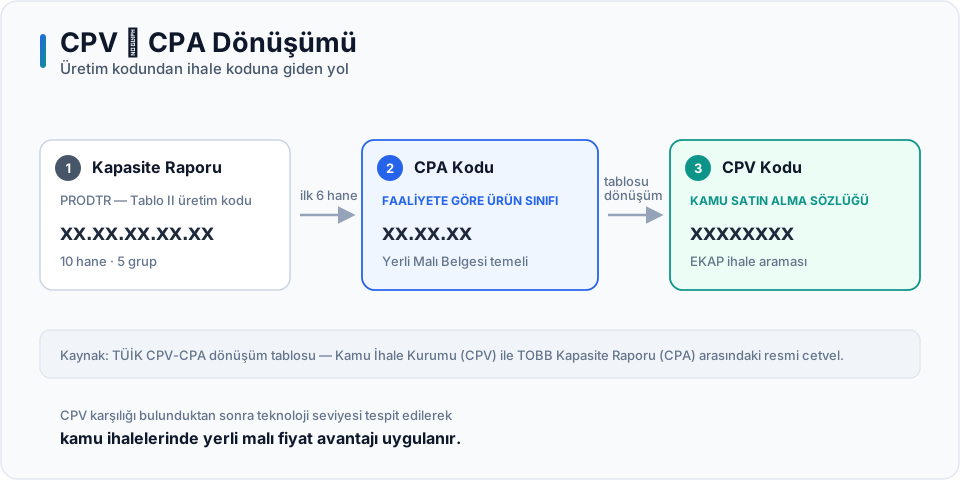
Step-by-Step: How to Use the CPV to CPA Conversion Table
Using the table involves five sequential steps. Each step uses the output of the previous one, so skipping the order leads to incorrect codes. The technology-level check is often overlooked, yet it is the most critical step for the domestic-product price advantage.
- 01Find the product code in your capacity report
Identify the production item in Table II of your capacity report along with its PRODCOM / CPA code. The first 6 digits of the PRODCOM code are the CPA code.
- 02Isolate the first 2–3–4 digits of the CPA code
The CPV to CPA conversion table matches at the first 2, 3, or 4 digits of the CPA code. Check which level gives you a match for your product.
- 03Read the corresponding CPV code from the table
Locate the row for your CPA code in the official conversion table and note the CPV code shown. This is the code you will use to search for tenders on procurement platforms.
- 04Verify the technology level
After finding the CPV code, check the relevant national medium-and-high-technology industrial products list to determine your product's technology level. This affects the domestic-product price advantage ratio.
- 05Search for relevant tenders
Use the CPV code you obtained to filter tenders matching your company on national and international platforms. TenderZoom automates this step on a single screen.
Example Conversion Table
Below are sample rows from the CPV to CPA conversion table. As shown, not every item has a CPA equivalent; agricultural and raw-material items are often marked "out of scope," meaning they cannot be assessed under domestic-product certificate rules.
| CPV Code | Item Name | CPA Equivalent |
|---|---|---|
| 03000000 | Agricultural, farming, fishing, forestry and related products | See sub-product groups (parent code) |
| 03111100 | Soya beans | Out of scope |
| 03115110 | Cotton | Out of scope |
| 03116100 | Natural rubber | Out of scope |
Domestic-Product Certificate and Technology Level
The most practical benefit of the CPV to CPA conversion table emerges in the domestic-product certificate process. Once you find the CPV code for your product, you can determine its technology level from the relevant national industry product list. The technology level directly affects the domestic-product price advantage ratio applied in public tenders.
In public tenders, a price advantage of up to a defined percentage (commonly up to 15%) may be applied in favour of bidders offering domestic products. For medium-high and high-technology products this advantage may be mandatory. This makes correct CPV-CPA matching not a mere formality, but a strategic step that defines your competitive position.
Why Does It Matter for Tenders?
The right CPV code determines which tenders are relevant to your company. When you convert your production profile to a tender code using the CPV to CPA conversion table, you will not miss opportunities that match your product in either national or international platforms. An incorrect or incomplete code can exclude you entirely from relevant tender alerts.
TenderZoom matches your company's sector and product profile to CPV/UNSPSC codes and presents the right tenders on a single screen. Instead of matching codes manually, use the tender search screen's "Suitable for Your Company" filter to see tenders that directly match you. For a sector overview, see the sector tender analysis and for bid preparation, see the 10 golden rules of bid preparation .
Frequently Asked Questions
Below we answer the most common questions about the CPV to CPA conversion table — from where to find it to the risks of incorrect matching.
Where can I download the CPV to CPA conversion table?
The table is prepared by the national statistical institute and published in Excel format on the relevant authority's domestic-product certificate page. Always verify the current version from the official source.
What is the difference between a CPV code and a CPA code?
A CPV code defines the subject of a tender (what is being bought) and is used on procurement platforms. A CPA code defines the production category of a product and is used in capacity reports and domestic-product certificate processes. The conversion table bridges the two.
Why are the first 6 digits of the PRODCOM code important?
Production items in a capacity report's Table II are coded with PRODCOM, and the first 6 digits of that code are directly equal to the CPA code. This lets you link your product to a CPV code via the CPV to CPA conversion table.
Does every CPV code have a CPA equivalent?
No. Agricultural and raw-material items are often marked as 'out of scope' in the conversion table; some parent codes redirect you to sub-product groups. Use the most detailed level of your code for accurate matching.
What are the consequences of an incorrect CPV-CPA match?
An incorrect match creates two key risks: first, tender eligibility is assessed wrongly and winnable opportunities are missed; second, the wrong technology level is assigned during the domestic-product certificate process, meaning the price advantage either cannot be used at all or leads to disqualification for improper use.
Source: Eurostat CPV-CPA conversion table and relevant national authority domestic-product certificate page. Always verify the latest version from the official source.


TenderZoom – International Tender Search Platform
Sign up free and follow the tenders that fit you.
Create your account, filter tenders, save your searches and get notified about new notices.